
The Italian island of Sicily might be known for the sea and resorts, but it’s looking to promote itself in a new light by highlighting vacations made up of long walks.
The island’s tourist board said that in a world where everything is a rush, it is possible to enjoy slow, more sustainable tourism, which does not distort the social and cultural fabric of the area, on the island.
The Belìce Valley is one of the areas of Sicily where the landscape cannot be separated from history. On the night of January 14-15, 1968, a series of quakes struck this area between the provinces of Trapani, Agrigento and Palermo. Towns such as Gibellina, Salaparuta, Poggioreale and Montevago were destroyed or rendered uninhabitable by the earthquake. There were hundreds of victims and tens of thousands displaced, and what followed was a long, complex reconstruction that changed the face of the valley forever.
New towns sprang up in different locations from the original cluster and, even today, the abandoned historic centres are skeletons suspended in time. Gibellina-which will be the Capital of Contemporary Art in 2026-is a symbol of this piece of history: Alberto Burri’s Cretto, a white concrete casting that covers the old urban layout, leaving the paths of the streets to emerge as if they were fissures, stands on the ruins. Aside from historic places, which are not limited to the Cretto, the Belìce Valley also has a natural heritage. The Belìce River and its tributaries run through countryside, forests and hilly areas that are ideal for bicycle routes and multi-day treks.
In the heart of Sicily, the Rocca di Cerere Unesco Global Geopark encompasses a complex territory where geological history, human history and the contemporary landscape meet. It is a 1,279-square-kilometre area in the province of Enna, whose name – Rocca di Cerere – recalls the ancient cult of Demeter, goddess of fertility, and the cycles of agriculture, which are such key features of these areas.
In just a few dozen kilometres, wet environments such as Pergusa Lake transition to holm oak and downy oak forests, and scenic cliffs, such as those of Mount Altesina, the highest peak in the Erei Mountains. This natural setting includes places of major historical and cultural importance, such as the Floristella-Grottacalda mining area, and several archaeological sites, going from Morgantina to the Villa Romana del Casale.
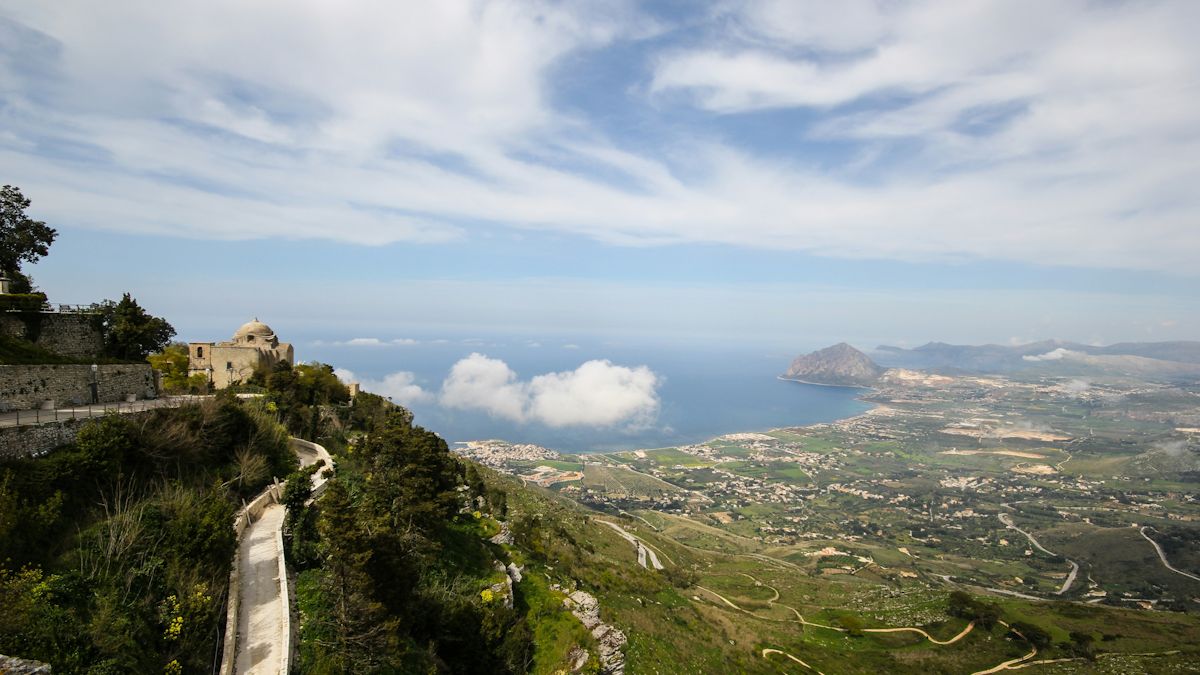
Moving westward, among the countless Sicilian routes linked to religious traditions, is the path of Sant’Anna, which allows you to climb up to Erice, on an itinerary that passes by the Sanctuary of Sant’Anna, dating back to the early 17th century. In the town there are monuments, from the Cathedral to the Castle of Venus via the Pepoli Tower. And, after more than 5 kilometres of walking uphill, Genovesi, a typical local sweet made of short pastry and cream, is a way to recharge.