

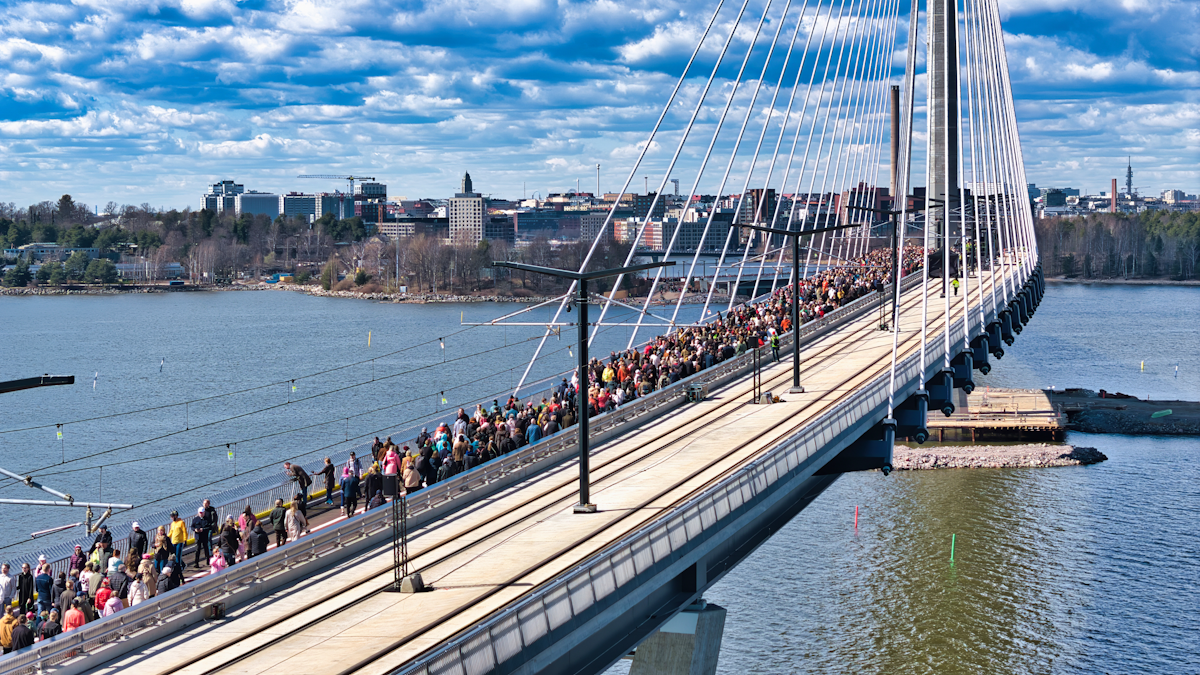
The new Kruunuvuorensilta bridge, connecting Korkeasaari and Kruunuvuorenranta, is the longest and tallest bridge in Finland.
The new bridge reduces the distance between Kruunuvuorenranta and the city centre from 11 km to approx. 5.5 km.
The new structure is also unusual as bridges of this size are rarely built exclusively for public transport, pedestrians and cyclists. In addition to its scale, the bridge stands out as an attraction due to the advanced traffic planning embedded in its design, while its architectural expression establishes a distinctive new identity for Helsinki’s skyline. The bridge opened to the public on Saturday, with more than 50,000 visitors during the opening weekend.
Kruunuvuorensilta spans 1,191 metres, making it the longest and tallest bridge in Finland. The bridge is part of the €326m Crown Bridges Light Rail project, one of Helsinki’s largest urban development initiatives, which includes three bridges and a new tramline connecting the city centre to Laajasalo island. The population of Laajasalo is expected to double by 2040, and the new connection will ensure smooth and reliable public transport for the growing area.
The central structural component and most visible feature of the bridge is its 135-metre-high diamond shaped pylon. Rising 135 metres above sea level, it is taller than Finland’s highest residential building, the Kalasatama tower (134 m), and higher than the Olympic Stadium tower (72 m). The construction of the pylon alone took approximately two years of continuous concrete casting.
“Kruunuvuorensilta bridge is the new, unique and exciting landmark for Helsinki. A sight that will draw visitors from near and far. The new bridge reshapes how we look at Helsinki. It attaches the areas of Kruunuvuorenranta and Laajasalo in a completely new way to the larger central city area. The bridge reflects our commitment to sustainable solutions and embraces Helsinki’s unique maritime setting,” said Mayor of Helsinki, Daniel Sazonov.
The bridge and the upcoming tramline reflect Helsinki’s long-term vision of prioritising public transport, walking and cycling in urban mobility. Currently, the majority of journeys in Helsinki are made using sustainable modes: around 41% on foot, 25% by public transport and 11% by bike, while only about 20% are made by car.
New districts such as Kruunuvuorenranta and Kalasatama have been planned around this principle, with the new connection enabling smooth, car-light mobility between them and the city centre. The tramway was selected as the primary mode of transport as it provides a fast and reliable connection, supports urban growth and reduces pressure on existing metro capacity. Allowing private car traffic on the bridge would have significantly increased congestion in central Helsinki.
Kruunuvuorensilta is designed to serve the city for generations, with a design life of up to 200 years. Together with its dedicated use for tram and active mobility, the bridge reflects Helsinki’s commitment to sustainable long-term urban mobility.
The project has included a comprehensive assessment of environmental impacts, covering waterways, fish populations, boating, as well as noise and vibration. The total carbon footprint is approximately 129,000 tCO₂e, of which 76% originates from construction and 24% from operation and maintenance over a 50-year period. Emissions have been reduced through the use of low-emission materials and renewable energy sources.
Helsinki’s coastal location brings a wide range of weather conditions, from bright summer days to windy and icy winters, placing diverse demands on infrastructure. The bridge’s stay cables are designed to remain in constant slight motion in the wind, which helps prevent ice formation. Ice accumulation is further reduced by enclosing the cables in textured plastic sheaths that cause ice to break off into fine particles. The bridge also features a wind warning system, with strong wind alerts displayed on light boards at both ends.