
New data released by the British Pilgrimage Trust show growing interest in pilgrimage routes within Britain, offering an alternative to travelling abroad.
The charity’s 2025 route data show strong demand for both ancient long-distance paths and short, accessible micro-pilgrimages across Britain. Since 2014, the charity has built the largest online repository of British pilgrimage routes and places.
For many people, pilgrimage is often associated with routes such as the Camino de Santiago and other global traditions. The Trust’s latest data, however, points to a growing rediscovery of Britain’s own ancient pilgrimage routes, which offer deep historical and spiritual significance without the need to travel overseas.
Today’s pilgrims cite wellbeing, nature connection and cultural heritage as key motivations, alongside spiritual practice and religious observance for many people.
To understand which pilgrimage routes people are actively considering, the Trust analysed route downloads from its website across England, Wales and Scotland.
The analysis shows strong interest across a wide range of pilgrimage lengths, from short, single-day pilgrimages to longer routes walked over several days or weeks.
Most downloaded in England was the St James’ Way, a 66-mile trek from Reading to Southampton. This hike is the official start of the Camino de Santiago in Britain. The route passes through the rolling countryside and open downs at the heart of the kingdom of Wessex.
Next was the longer Pilgrims Way, which covers 153 miles from Winchester to the Canterbury North Downs Pilgrims Way. Perhaps the most well-known pilgrimage route in Britain, it was first walked as a pilgrimage in 1172 from Winchester to Canterbury where Thomas Becket was buried after he was martyred two years earlier. But walking this path reveals evidence of the pathways being well-used for thousands of years before that date.
The short, 13-mile St Michael’s Way in Cornwall was third on the list in England. It is a cost-to-coast micro-pilgrimage in the westernmost part of Cornwall.
In Wales, the North Wales Pilgrims Way from Holywell to Bardsey Island topped the list. Pilgrims have been drawn to Bardsey Island for hundreds of years. This 140-mile route includes a holy water swimming pool, prehistoric stone circles, ancient churches, 1,000-year-old stone crosses, sacred springs and waterfalls.
The 72-mile Lleyn Pilgrims Trail linking Aberdesach and Porthmadog was second on the download list in Wales. Based on an ancient pilgrimage path, this route runs along remote coast paths and unspoilt land and offers views of the Irish coast, Snowdonia, Anglesey and Bardsey Island.
The Anglesey Saints Way, a route extending 44 miles from Penmon to Anglesey, follows the path taken by two friends – St Cybi and St Seiriol – who walked to meet each other every day at the well of Clorach. The route includes Holyhead Mountain — considered one of the most sacred Druidic sites in all Europe.
In Scotland, a not for the faint-hearted journey of 261 miles was the most downloaded route. St Columba’s Way, from Iona to St Andrews, crosses the entire width of Scotland, this route starts on the historic isle of Iona, burial grounds of the Kings of Scotland.
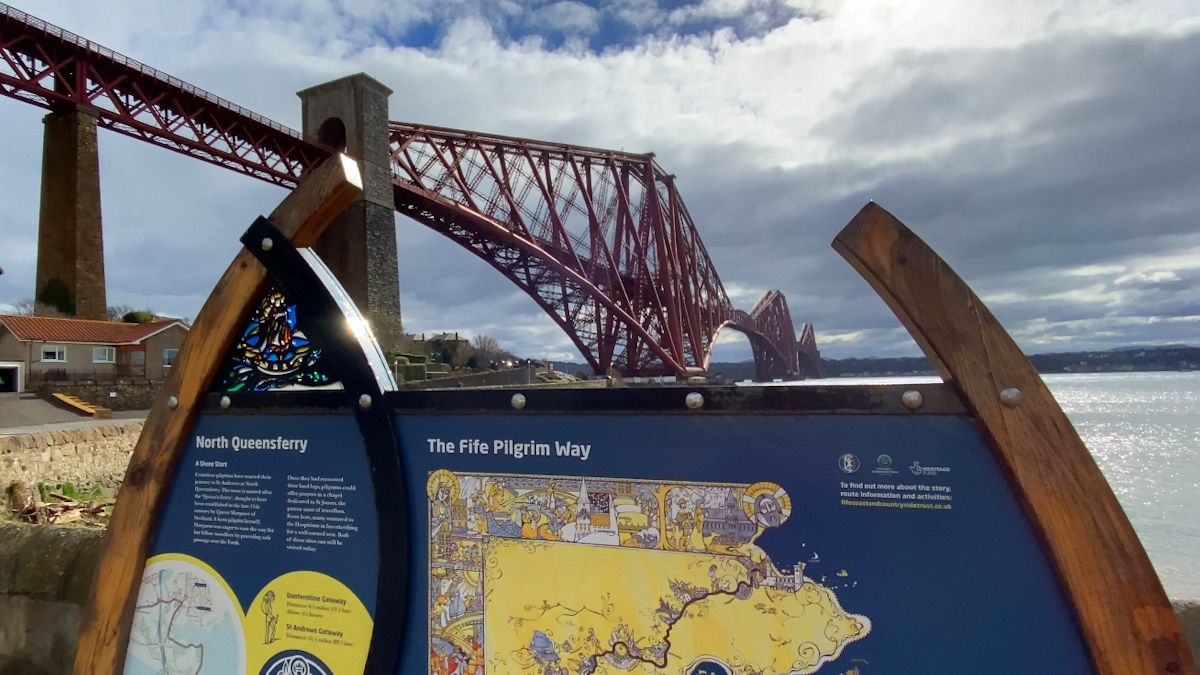
At the other end of the scale was Scotland’s second most popular route for downloads. At 10 miles, the Edinburgh Cathedral Pilgrimage in a Day starts at one of the most famous and mysterious churches in Scotland, Rosslyn Chapel.
The longest route downloaded, which made number eight on the Welsh list, is the 758-mile trek known as the Celtic Way, from Strumble Head, Pembrokeshire to St Michael’s Mount, Cornwall, which connects the ancient stones and sacred waters of Pembrokeshire, Stonehenge, Glastonbury and St Michael’s Mount. But you’re not doing it in a day.
While these routes are historically rooted in religious practice, they are walked today for many reasons. For many people, their significance lies not only in belief but also in what they carry as cultural inheritance, offering a way to move through landscape with intention.
The resurgence of pilgrimage in Britain coincides with the Catholic Jubilee Year of 2025, a tradition that has long encouraged pilgrimage. While the timing is notable, the Trust observes that today’s revival also reflects wider cultural currents.
Pilgrimage is an ancient practice, but its renewed appeal today reflects contemporary pressures such as the pace of modern life and constant connectivity. Setting out on foot along routes shaped by centuries of use offers a deliberate contrast, creating space for reflection and attentiveness to landscape and history.
For many people, pilgrimage is often associated with routes such as the Camino de Santiago and other global traditions. The Trust’s latest data, however, points to a growing rediscovery of Britain’s own ancient pilgrimage routes, which offer deep historical and spiritual significance without the need to travel overseas.
“Historically, pilgrimage has often resurfaced at moments of social change,” said Guy Hayward, co-founder of the British Pilgrimage Trust.
“What feels different now is that people are rediscovering pilgrimage not only as a religious practice, but also as a shared human one. It has become a way of walking with intention and care, whatever your beliefs. Britain’s churches and sacred spaces have long offered hospitality to pilgrims, and many remain open places where anyone can pause and reflect. Through networks like our charity’s Sanctuary Network, pilgrims can now sleep in churches along the way.”
Earlier YouGov research commissioned by the charity in 2025 helps explain this renewed interest. It found that while curiosity about pilgrimage is high, the biggest barrier remains the perception that pilgrimage is only for the religious. People also cited concerns about cost, time constraints and logistical complexity. In practice, many are surprised to discover that a meaningful pilgrimage can be undertaken in a single day, with minimal equipment and little or no expense.
Since its founding in 2014, the British Pilgrimage Trust has met, spoken with and guided thousands of pilgrims. In its own surveys, people most commonly cite emotional and mental wellbeing, connection with nature, spiritual curiosity, and Britain’s rich cultural heritage as their motivations. These lived experiences continue to shape the Trust’s work.
For many, the appeal of pilgrimage lies not simply in the act of walking, but in walking towards something meaningful. Across Britain, people continue to journey to places long held as significant, including holy wells and springs, ancient trees, caves and hilltops, chalk figures, boundary stones, and churches, abbeys and cathedrals. These are places shaped by people over centuries.